
 A morning spent watching a great blue heron taught me that patience is not passive, but a form of attention.
The Language of Reeds: Reading Wind Across a Marsh
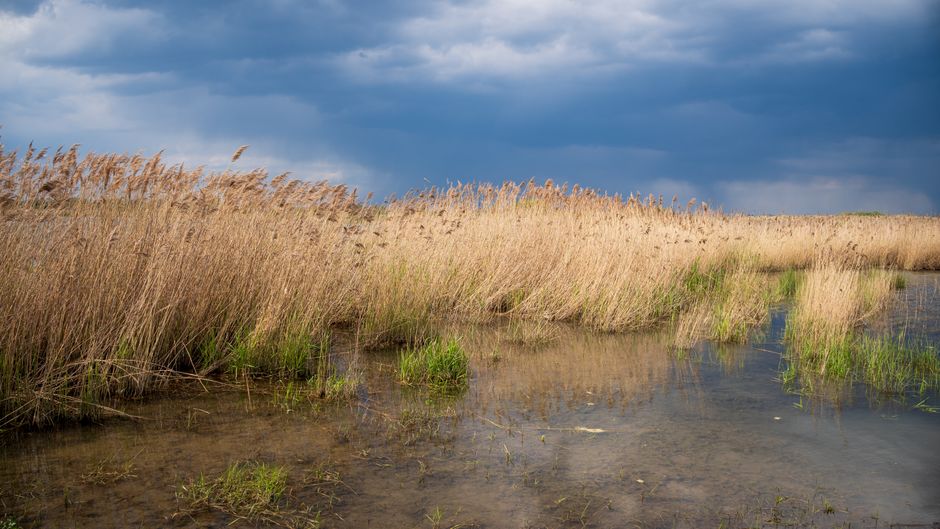
There is a particular hour in late September when the marsh stops being a place and becomes a conversation. The reeds have gone to seed, their heads heavy and pale, and when the wind moves through them they do not simply bend — they pass something along, stem to stem, a message that begins at the far edge of the water and arrives at your feet a few seconds later, slightly changed. I have spent whole afternoons trying to learn this language, and I suspect I have only managed a few words of it.
People who live near wetlands know this instinctively. They will glance at a reed bed and tell you which way the weather is turning, not because they have checked a forecast, but because the reeds have already told them. It is an old literacy, older than writing, and it is fading in most of us who grew up inland, surrounded by screens and straight lines. Standing at the edge of a marsh, you feel a little illiterate at first. Then, slowly, the sentences begin to parse.
What the Wind Writes
Watch a reed bed long enough and you notice that the wind does not move it uniformly. There are ripples and pauses, sudden rushes and long exhales. A gust from the north arrives with a certain crispness, a dry rustle that sounds almost like paper. A softer wind from the west carries a wetter note, as if it had crossed the river somewhere upstream and picked up the smell of it. The reeds translate all of this into motion, and if you close your eyes, into sound.
Poets have always loved this. From the psalms to the Romantics to the small, quiet verse written by people who simply live near water, the reed has been a figure for fragility that endures. It bends but does not break. It is hollow but not empty. It speaks without a mouth. These are not just pretty metaphors; they are accurate descriptions of a plant that has survived ice ages by learning to yield.
What strikes me most, though, is the patience required to hear any of it. The marsh does not perform. It does not care whether you are listening. If you arrive in a hurry, you will leave with nothing but wet shoes. If you arrive willing to stand still for twenty minutes, the whole place will begin to speak, and you will wonder why you ever thought silence was the same as emptiness.
Learning to Stand Still
I have started keeping a small notebook in my coat pocket, mostly for these walks. Not to record anything profound — usually just a line or two about the light, or the way the water held a particular shade of grey. But over a season, a strange thing happens. The notes stop being about the marsh and start being about attention. How hard it is. How worth it. How the reeds, in their patient way, are teaching me to be a slightly better listener, not just to wind but to people.
If you live near a wetland, go and stand at its edge this week. Do not bring a camera. Do not bring a plan. Bring only the willingness to be bored for a while, and then, perhaps, to be surprised. The reeds will do the rest. They have been waiting for someone to read them, and they are not in any hurry.