
 There is a kind of fog that only forms over slow water at dawn, and it asks of us nothing except that we slow down enough to be inside it.
What the Heron Knows About Waiting
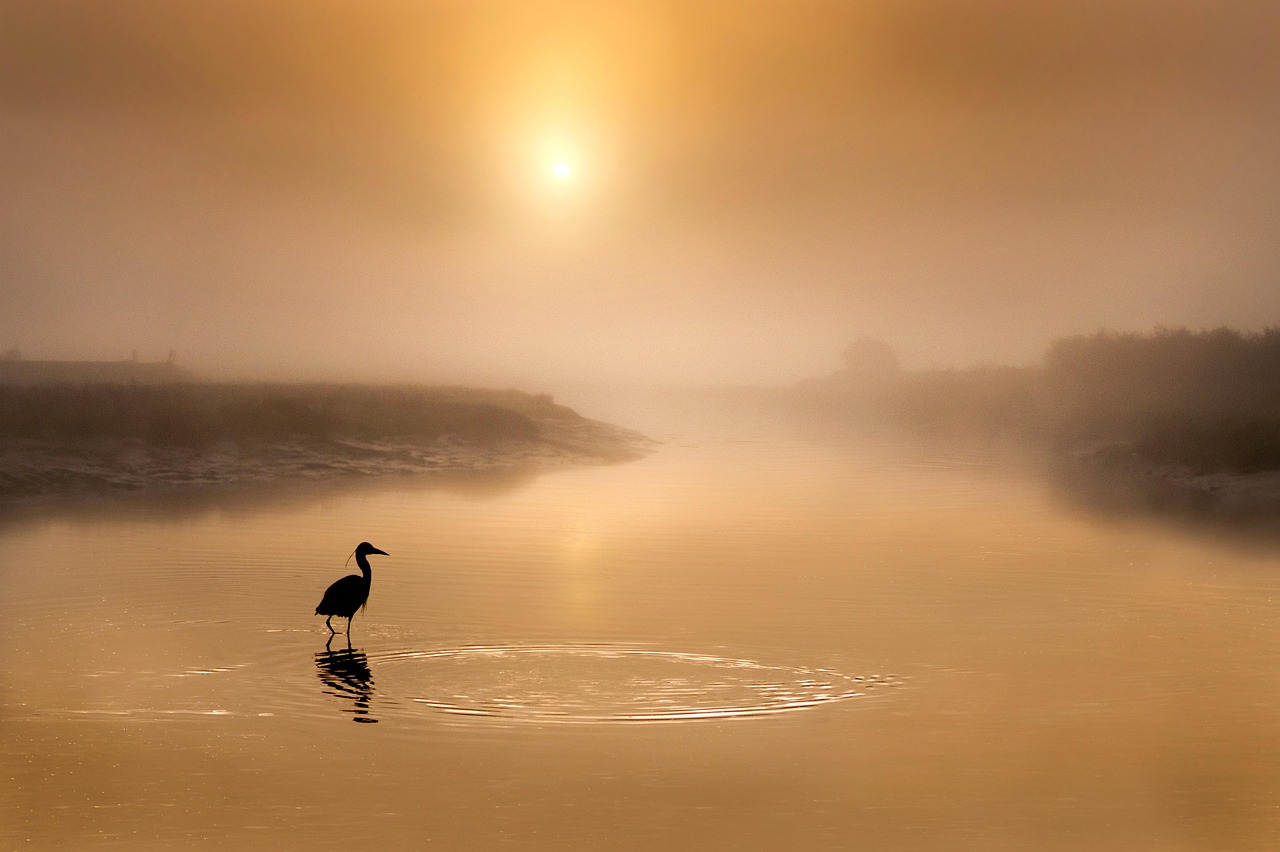
The heron arrived before I did, though I had been sitting on the bank since before sunrise. One moment the shallows were empty, just gray water sliding over gray stones, and the next he was there — a thin, improbable silhouette against the mist, as if the marsh had simply decided to grow a bird. I had come out with a notebook and a thermos, the way I always do when I need to think, but the heron did not seem interested in my thinking. He stood in the cold water with the stillness of a fence post and did not move for forty minutes.
I know it was forty minutes because I checked my watch twice, then a third time, feeling vaguely ashamed of myself. What was he doing out there? Nothing, by any measure I understood. And yet his nothing had a quality to it that my somethings rarely did. His neck was coiled, his eye fixed, his whole body pitched toward the water like a question waiting for its answer. He was not resting. He was not idling. He was waiting, in the fullest sense of the word, and the waiting itself seemed to be a kind of work.
The Discipline of Standing Still
We tend to treat patience as a virtue of endurance — something we grit our teeth and bear. But the heron suggested something else. His stillness was not gritted. It was alert, almost luxurious, the stillness of a creature perfectly suited to its moment. He had no phone to check, no inbox to refresh, no itch to scratch. He had only the water, and the small silver possibility moving somewhere beneath it, and the long, unbroken attention that would eventually close the distance between them.
I thought about all the times I had mistaken motion for progress. The walks I took while rehearsing arguments in my head. The books I read with one eye on the clock. The conversations I half-heard while planning what to say next. I was rarely still, and when I was still, I was rarely there. The heron had no such problem. He was so entirely present that the marsh seemed to arrange itself around him — the light, the reeds, the slow drift of duckweed, all of it held in the orbit of his patience.
When he finally struck, it was almost too fast to see. A flash of neck, a splash, a silver fish twisting in the air, and then the old stillness again, as if nothing had happened. He swallowed, adjusted his footing, and resumed his post. The whole thing had taken perhaps two seconds. Forty minutes of waiting for two seconds of living — and yet I understood, watching him, that the two seconds were not the point. The waiting was the point. The waiting was where the heron lived.
What We Miss When We Rush the Shallows
I have been trying, since that morning, to bring a little of the heron into my days. Not literally, of course — I have no interest in standing in cold water for hours, and my wife would have questions. But I have been trying to notice the difference between waiting and wasting time. They look identical from the outside. Both involve stillness, silence, the absence of visible productivity. But one is a kind of listening, and the other is just a slow form of leaving.
The marsh does not reward hurry. The heron knows this. The turtles know it, hauling themselves onto logs with the gravity of small boulders. The herons and the turtles and the patient green herons of the world are not lazy; they are simply tuned to a rhythm most of us have forgotten how to hear. The fish do not arrive on schedule. The light does not wait for our convenience. The best things in a wetland come to those who are willing to stand in the shallows and let the morning happen around them.
I did not write anything in my notebook that day. I did not need to. The heron had already written it, in the only language that matters out here: the language of staying put, of paying attention, of trusting that the water will eventually give up what it is hiding. I walked home slowly, the mist burning off behind me, and I have been trying, ever since, to carry a little of that cold, patient water in my chest.